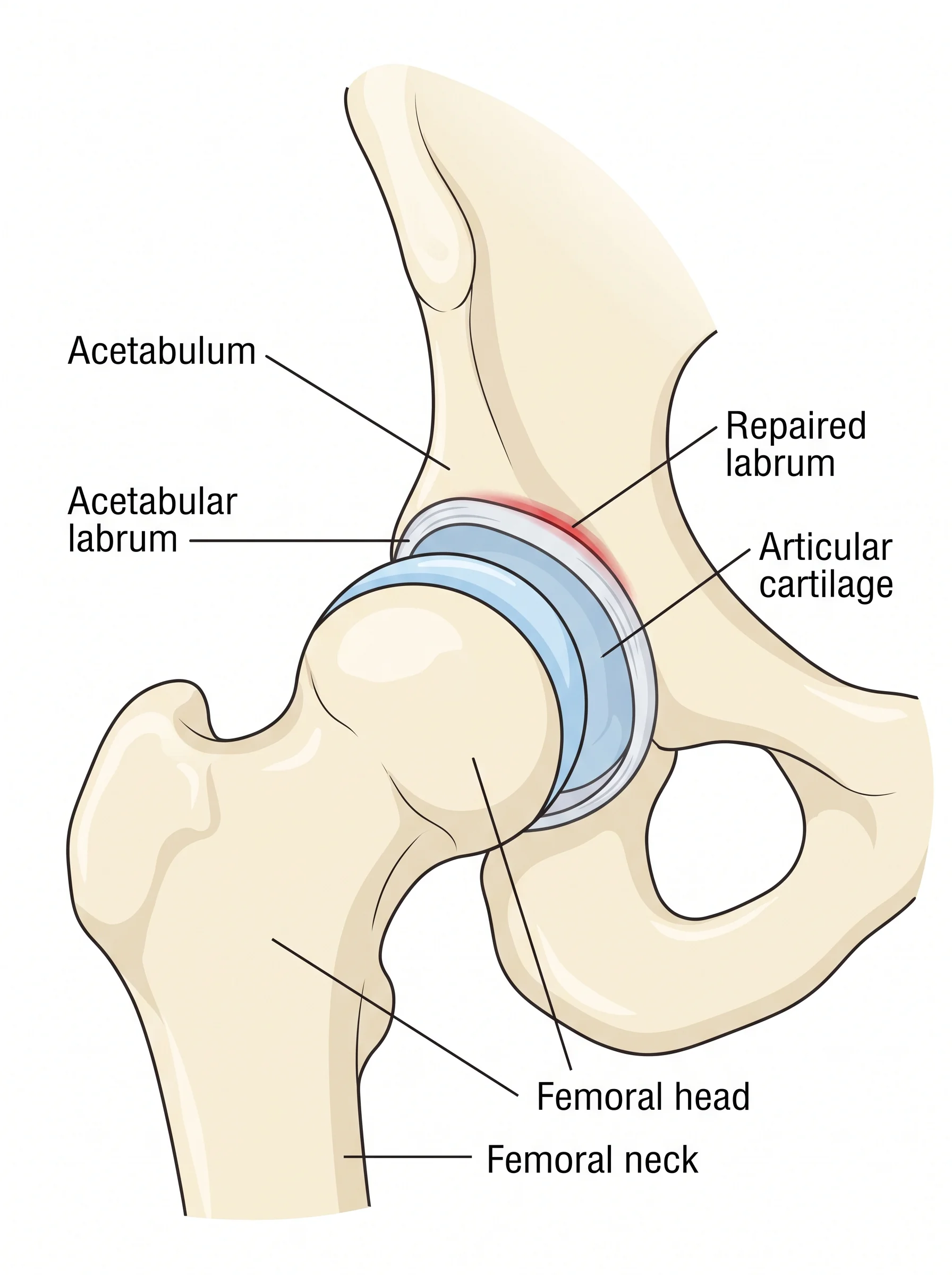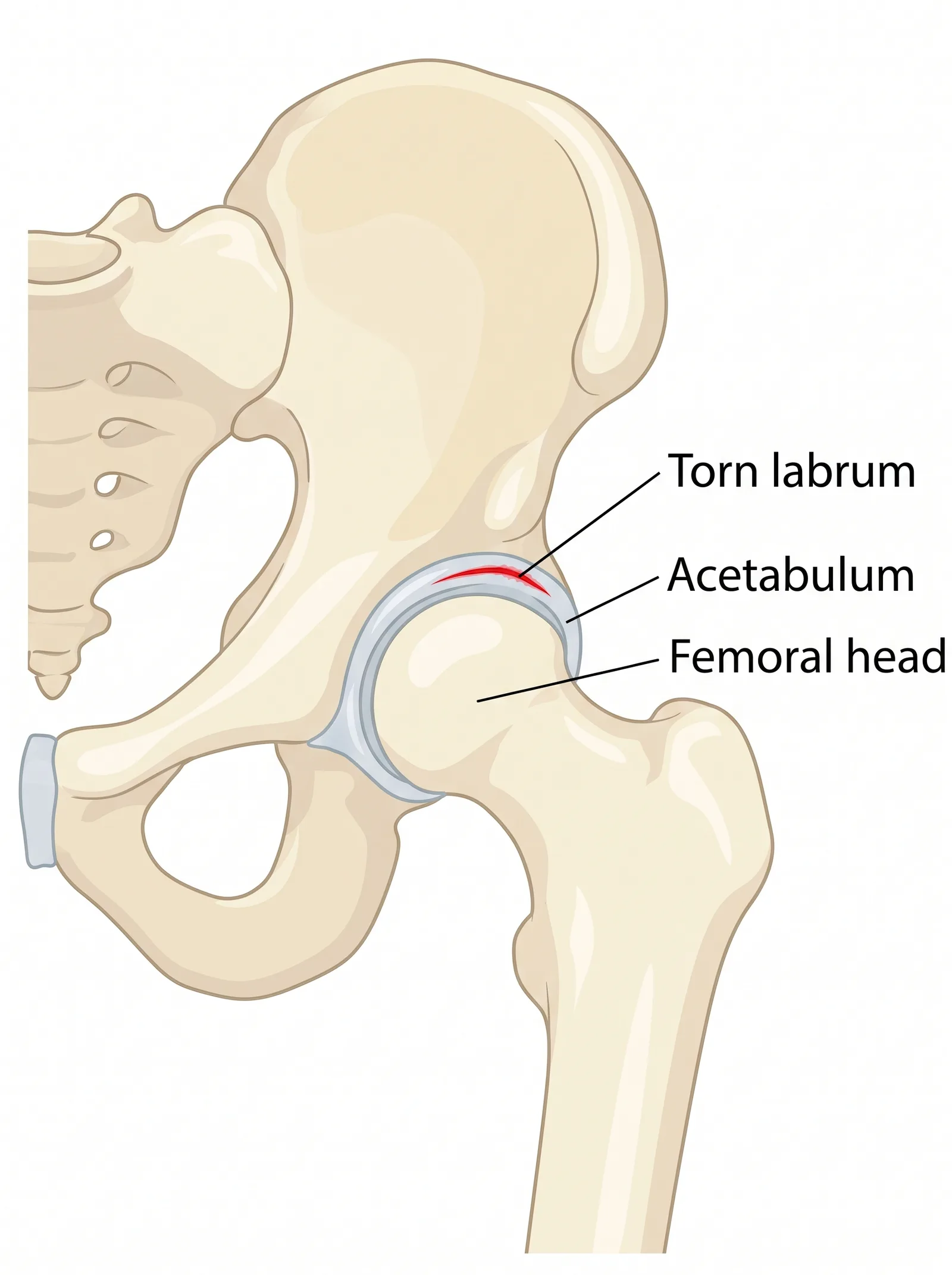
A hip labral tear is an injury to the ring of cartilage that lines the rim of the hip socket. It can cause groin pain, catching, and stiffness. Dr. McMillan evaluates hip labral tears in Burlington Township and treats them with options that begin with non-surgical care and include arthroscopic repair when needed.
Sean McMillan diagnoses and treats hip labral tear in Burlington Township, from the first visit through recovery.
What do patients ask most?
Can a hip labral tear heal on its own?+
Do I need surgery for a hip labral tear?+
What does a hip labral tear feel like?+
Is a labral tear the same as hip impingement?+
What is Hip Labral Tear?
The labrum is a ring of firm cartilage around the edge of the hip socket.
It deepens the socket, helps hold the ball of the joint in place, and cushions movement. A tear is a split or fraying in that ring.
Labral tears can come from a single injury, from repeated twisting and pivoting in sports, or from the shape of the hip bones, which is called impingement. Some tears also appear alongside early arthritis.
Common symptoms are a deep ache or sharp pain in the groin, a catching or clicking feeling, and stiffness. Pain often increases with long sitting, walking, or pivoting. Some people have no symptoms at all, and a tear is found while looking for something else.
How is Hip Labral Tear diagnosed, and what does the visit involve?
A hip labral tear is diagnosed with a history, a physical exam, and imaging.
Your physician asks about your symptoms and moves the hip through positions that stress the labrum to see what reproduces the pain. X-rays check the shape of the bones and look for arthritis. The clearest picture of the labrum comes from an MRI, a scan that shows soft tissue, often with a contrast dye placed in the joint to outline a tear.
What is recovery like for Hip Labral Tear?
Many labral tears improve with time, therapy, and activity changes, so non-surgical care is usually the first step.
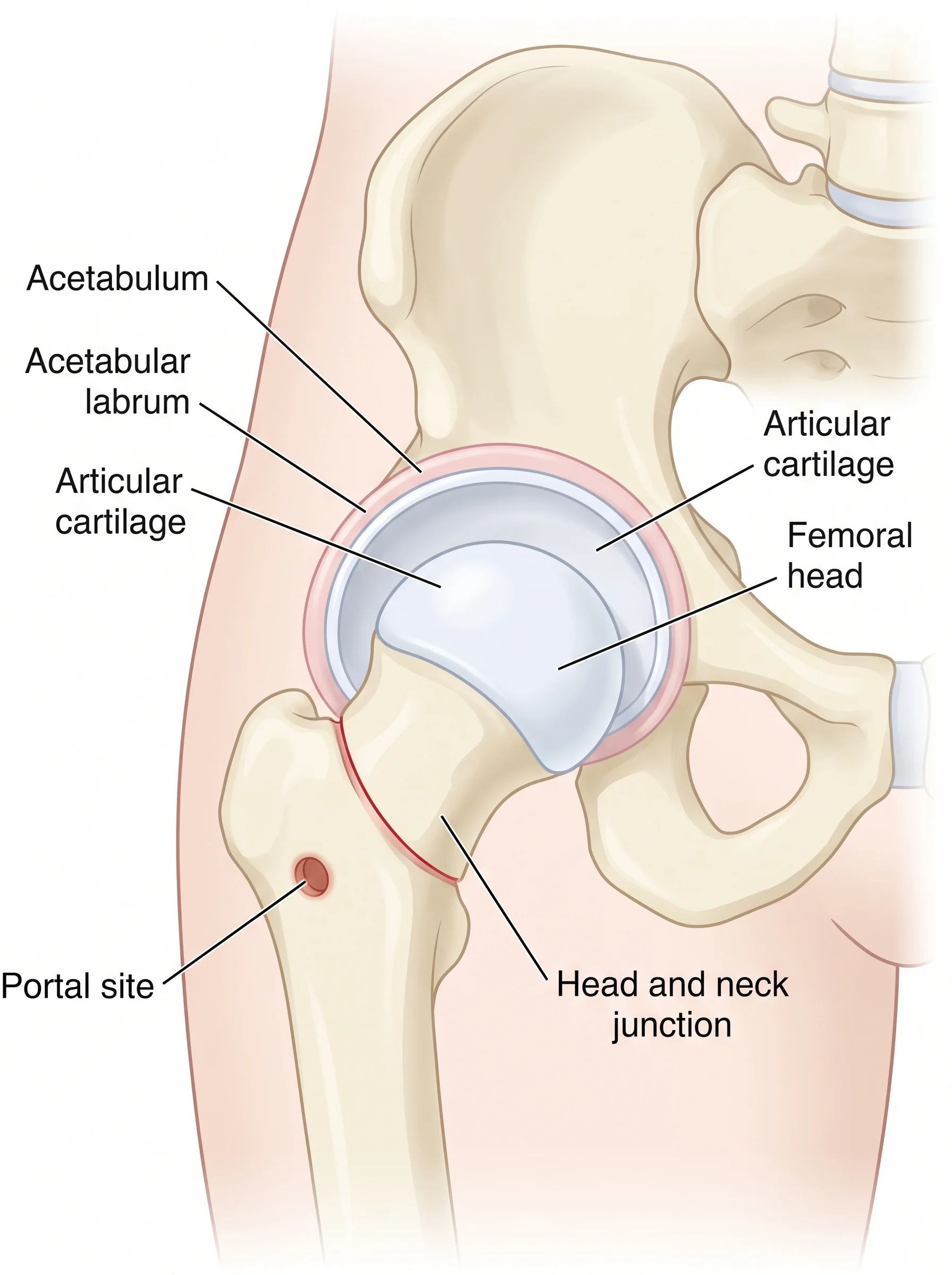
When pain continues to limit activity, or when the tear is linked to the shape of the bones, arthroscopic treatment may be discussed. The right path depends on your symptoms, your activity goals, and what the imaging shows. Your physician will review the options with you.
What are the treatment options?
- 01Rest and activity changes to avoid the movements that trigger pain, such as deep pivotingRest and activity changes to avoid the movements that trigger pain, such as deep pivoting.
- 02Physical therapy to strengthen the hip and core and to improve the way the joint movesPhysical therapy to strengthen the hip and core and to improve the way the joint moves.
- 03Anti-inflammatory medication, when appropriate and reviewed with your physicianAnti-inflammatory medication, when appropriate and reviewed with your physician.
- 04A guided injection into the joint, which can ease pain and help confirm the source of itA guided injection into the joint, which can ease pain and help confirm the source of it.
- 05Hip arthroscopy, a surgery using a small camera and thin instruments through tiny incisionHip arthroscopy, a surgery using a small camera and thin instruments through tiny incisions, to repair or trim the labrum when non-surgical care does not resolve symptoms.
Who treats hip labral tear in Burlington Township?
Sean McMillan is a board certified orthopedic surgeon who treats hip labral tear in Burlington Township, NJ. Fellowship trained at University of Massachusetts, Worcester, MA (Arthroscopic Sports Medicine: Shoulders, Hips, Knees and Elbows). Dr. McMillan sees patients at the practice in Burlington Township; appointments can be requested through this site.
How do payments work?
Contact the office to confirm insurance participation.
Fellowship trained at University of Massachusetts, Worcester, MA (Arthroscopic Sports Medicine: Shoulders, Hips, Knees and Elbows). Sees patients in Burlington Township.
About Dr. McMillan →