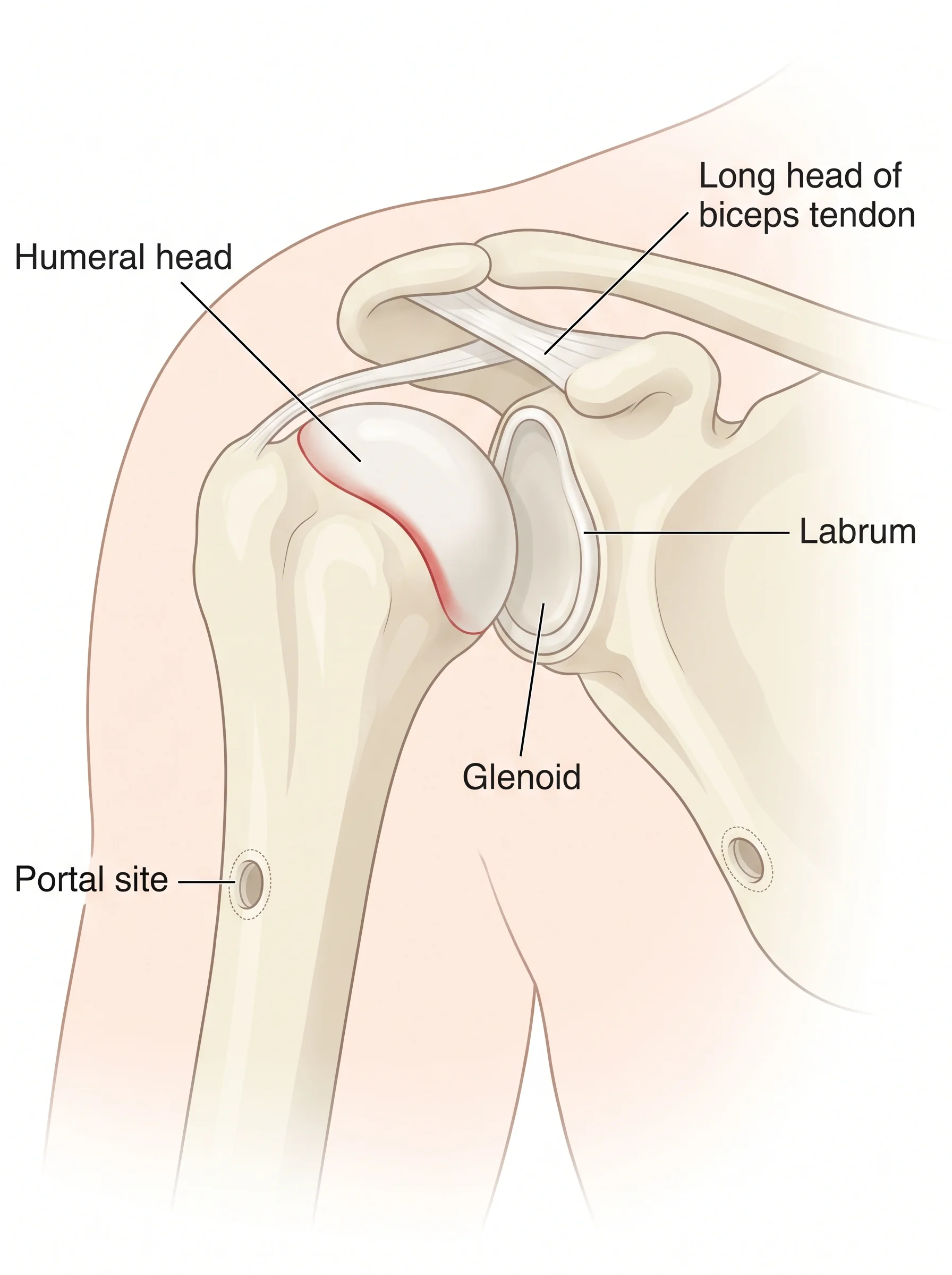
What is a SLAP or labral tear?
The labrum is a rim of cartilage that lines the shoulder socket and makes it a little deeper, helping keep the ball of the shoulder centered and giving the ligaments a firm anchor.
A labral tear is any tear in this rim. A SLAP tear is a specific kind of labral tear at the top of the socket. SLAP stands for superior labrum anterior to posterior, which describes a tear across the top of the rim, running from front to back, in the area where the biceps tendon of the upper arm attaches.
These tears happen in a few ways. A single injury, such as a fall onto an outstretched arm or a hard pull on the arm, can tear the labrum. Repeated overhead motion, common in throwing and racquet sports, can wear the top of the labrum over time. The labrum can also fray with age.
Because the labrum sits deep in the joint and is close to the biceps tendon, symptoms can be vague and overlap with other shoulder problems. Sorting out whether the labrum is the source is a job for a specialist.
What are the symptoms of SLAP Tear and Labral Tear, and when should you see a specialist?
People with a SLAP or labral tear often describe a deep, hard-to-pinpoint shoulder pain.
Common signs, in patient words.
- A deep ache inside the shoulder, often worse with overhead motion. - Catching, locking, popping, or grinding when you move the arm. - A sense that the shoulder is weak or not quite stable. - Pain with specific actions like throwing, reaching back, or lifting overhead. - Loss of power or accuracy in overhead sports.
It is reasonable to see a shoulder specialist when deep shoulder pain, catching, or weakness lasts more than a few weeks, limits sport or work, or follows a specific injury. Because labral symptoms overlap with other shoulder conditions, a specialist evaluation is how the source gets identified. This section explains the condition; it does not tell you which problem you have.
How is a SLAP or labral tear diagnosed?
Diagnosis begins with your history and a physical exam.
Your specialist asks how the pain started, what motions bring it on, and whether you do overhead activity or had a specific injury. During the exam, the specialist moves the arm through positions that stress the labrum and the biceps attachment, checking for pain, catching, and weakness. No single test proves a labral tear, so the specialist uses a group of findings together.
Imaging adds detail. X-rays check the bones. To see the labrum, an MRI (magnetic resonance imaging, a scan that shows soft tissue in detail) is used, often with a dye placed in the joint to outline the labrum more clearly. Even with imaging, labral tears can be hard to confirm, and sometimes the final picture comes together only when all the pieces are considered. Your specialist ties the exam and images together.
What happens during labral repair?
When surgery is chosen, most labral repairs are done with arthroscopy (a technique using a small camera and thin instruments through small cuts).
The general sequence.
- You receive anesthesia so you feel no pain, and your team reviews the plan with you. - The surgeon makes small cuts and inserts the camera and instruments. - The joint is inspected to confirm the labral tear and to check the biceps attachment and other structures. - Depending on the tear, the labrum is reattached to the rim of the socket, or the biceps attachment is addressed with a different technique. - When the labrum is repaired, small anchors placed in the bone hold it in place while it heals. - The cuts are closed and the arm is placed in a sling.
Because the right procedure depends on the tear type, the person's age, and their activity, the specific plan is decided with your surgeon.
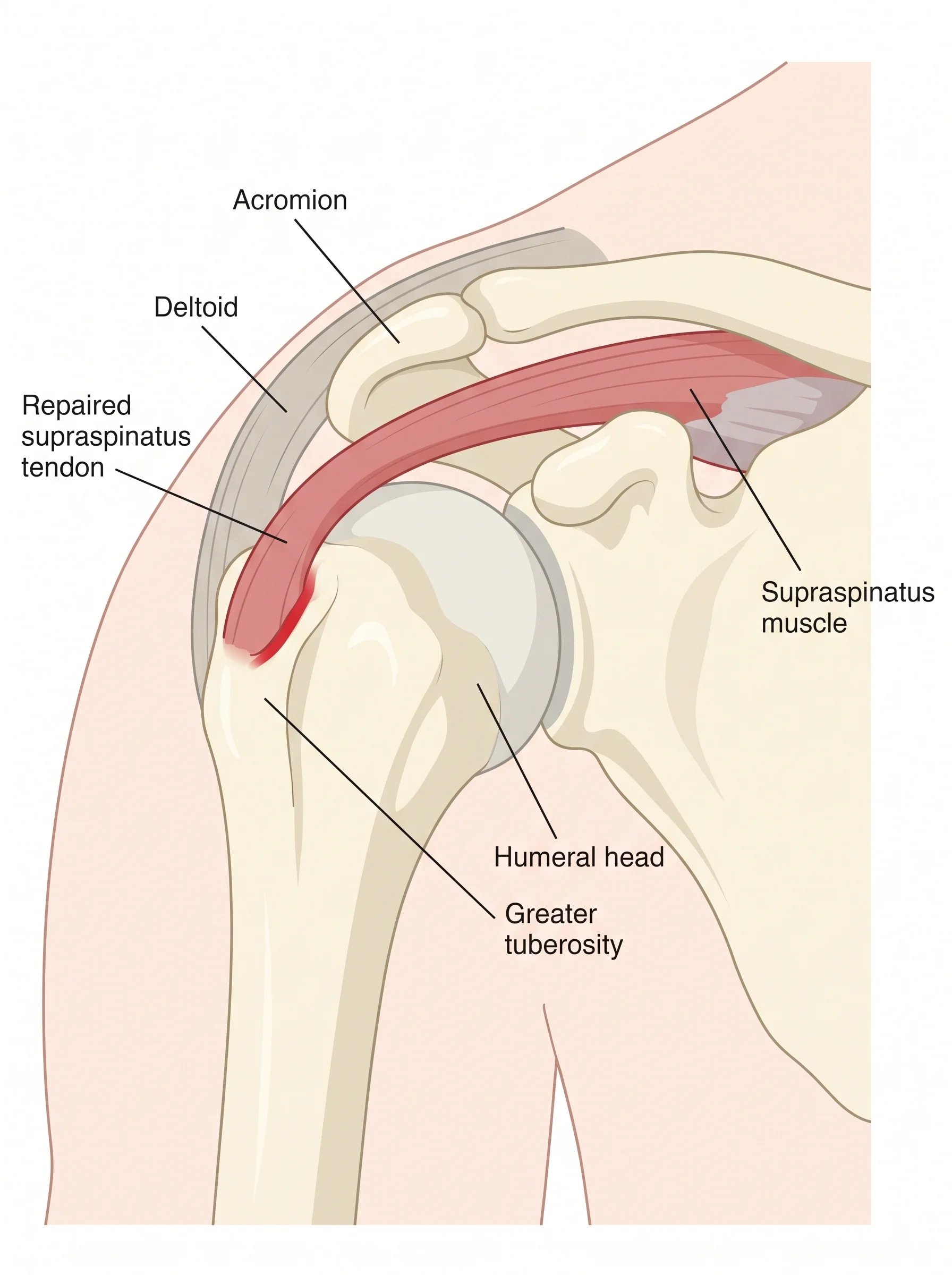
What is the recovery timeline for SLAP Tear and Labral Tear?
Recovery from labral surgery is staged and measured by ability, since repaired tissue must heal before the shoulder is loaded in demanding positions.
The general order of milestones.
- Protect. The arm rests in a sling early on so the repair can begin to heal. - Regain motion. You work back to comfortable motion under guidance, avoiding stressful positions at first. - Rebuild strength. Strengthening the cuff and shoulder-blade muscles restores control. - Return to activity and sport. Return is staged, with overhead and throwing activities usually last, once strength and mechanics meet the demand.
For a sense of length, recovery and return to overhead sport after labral surgery often take several months, according to general guidance from the American Academy of Orthopaedic Surgeons (AAOS). These are ranges, not promises. Your timeline depends on the procedure, your sport or job, and rehabilitation. Your team will map it with you.
How should you prepare for surgery?
Planning ahead eases the first weeks, since one arm will be in a sling.
- Home setup. Keep daily items within reach at waist height. Front-opening shirts are easier than pullovers. A recliner or wedge pillow can help with rest. - Transportation. Arrange a ride home after anesthesia, and plan for rides while you are in the sling. - Time off. Ask your surgeon what to expect for your job, and for your sport if you are an athlete. - Help on hand. Have someone available for the first few days for meals, dressing, and errands.
Which warning signs should you call about?
Most recoveries are uneventful, but some signs need a call.
Contact your specialist's office or surgical team if you notice the following.
- Fever, spreading redness, or drainage from an incision. - Pain that is worsening rather than easing, or is not controlled by your plan. - New numbness, tingling, or a hand that looks pale or feels cold. - Calf pain or swelling, chest pain, or shortness of breath. These need urgent attention and may mean calling emergency services rather than the office.
When in doubt, call the office.
What results can you expect from SLAP Tear and Labral Tear?
Outcomes after treatment for SLAP and labral tears depend on the tear, the person's age, and their activity demands.
Many people, particularly those treated with therapy or with a well-matched procedure, regain comfortable, functional shoulders. According to general guidance from the American Academy of Orthopaedic Surgeons (AAOS), recovery of function is common, and return to overhead sport takes time and is not guaranteed for every athlete. These are general findings and ranges, not promises. Your surgeon can explain your likely result based on your tear and goals.
What are the treatment options?
- 01Activity changesReducing or adjusting overhead activity and the motions that trigger pain gives the labrum a chance to calm down.
- 02Physical therapyStrengthening the rotator cuff and shoulder-blade muscles improves control and takes stress off the labrum. For overhead athletes, therapy also works on mechanics. This is the core of non-surgical care.
- 03Anti-inflammatory medicineOver-the-counter medicine can help with pain during flares. Use as directed and check with your specialist about other conditions.
- 04Cortisone injectionIn some cases, a shot of anti-inflammatory medicine can lower pain enough to progress with therapy.
What do patients ask most?
What is the difference between a labral tear and a SLAP tear?+
Can a labral tear heal without surgery?+
Why is my diagnosis uncertain?+
How long until I can throw again?+
Education and training
Medical school at Philadelphia College of Osteopathic Medicine, Philadelphia, PA. Residency at Peninsula Hospital Consortium- North Shore Long Island Jewish Health Systems, Long Island, NY. Fellowship at University of Massachusetts, Worcester, MA.
- FellowshipUniversity of Massachusetts, Worcester, MAArthroscopic Sports Medicine: Shoulders, Hips, Knees and Elbows
- ResidencyPeninsula Hospital Consortium- North Shore Long Island Jewish Health Systems, Long Island, NYOrthopedic Surgery
- Medical schoolPhiladelphia College of Osteopathic Medicine, Philadelphia, PADO
- Board statusAmerican Board of Orthopaedic SurgeryBoard certified
Dr. Sean McMillan Orthopedics & Sports Medicine
Burlington Office
2103 Burlington-Mount Holly Road
Burlington Township, NJ 08016
Phone(609) 747-9200
Dr. Sean McMillan Orthopedics & Sports Medicine
Cherry Hill Office
325 NJ-70
Cherry Hill Township, NJ 08034
Phone(609) 747-9200
Dr. Sean McMillan Orthopedics & Sports Medicine
Centennial Surgery Center
502 Centennial Blvd
Voorhees Township, NJ 08043
Phone(609) 747-9200
Dr. Sean McMillan Orthopedics & Sports Medicine
Mount Holly Hospital
175 Madison Ave
Mt Holly, NJ 08060
Phone(609) 747-9200
Dr. Sean McMillan Orthopedics & Sports Medicine
South Jersey Surgical Center
130 Gaither Dr #160
Mt Laurel Township, NJ 08054
Phone(609) 747-9200
Dr. Sean McMillan Orthopedics & Sports Medicine
Professional Orthopaedics - Sports Medicine & Arthroscopy
2103 Burlington-Mount Holly Rd
Burlington, NJ 08016
Phone(609) 747-9200